
Sergei Sergejewitsch Prokofjew
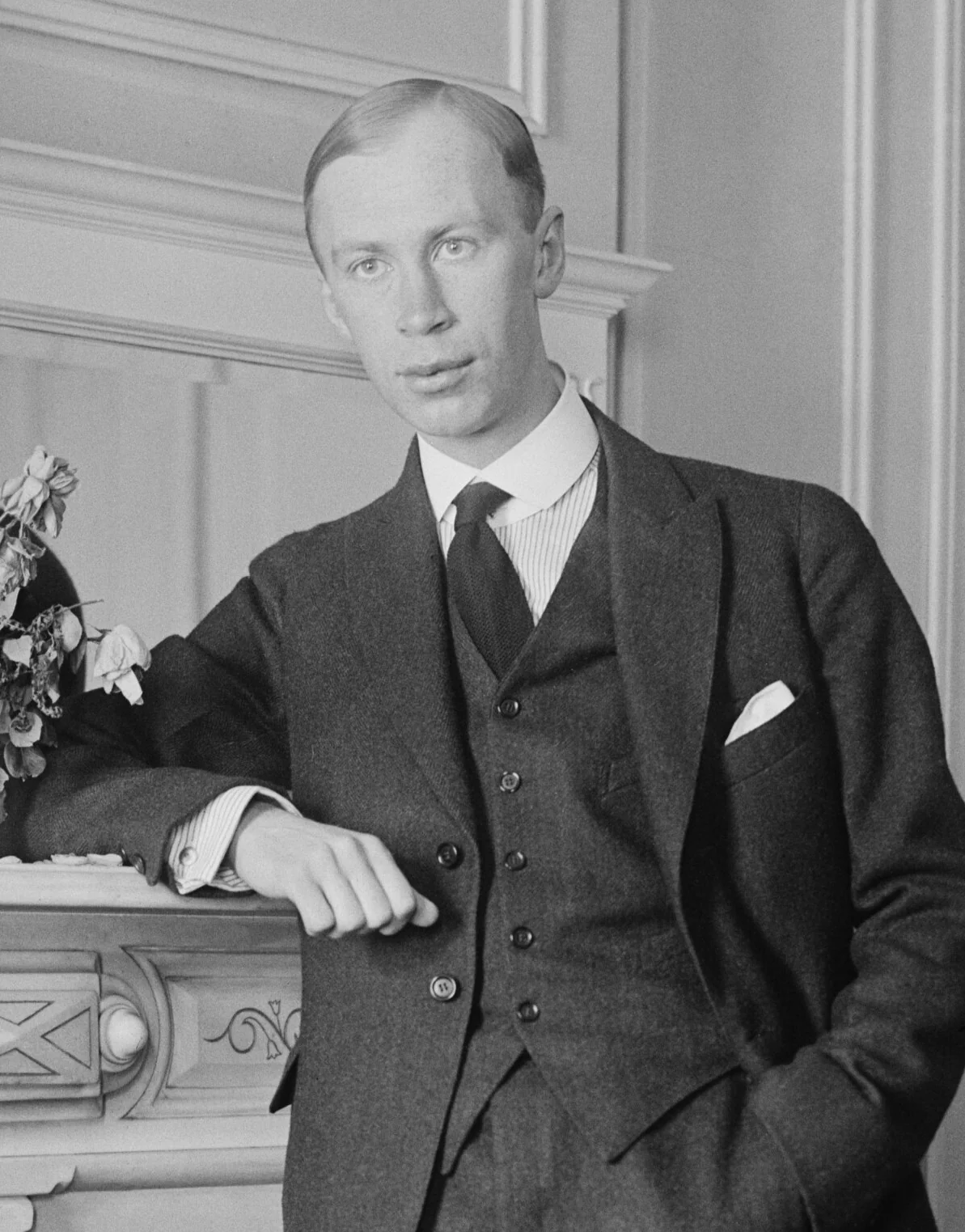
Image from Wikipedia
Image from Wikipedia
Sergei Sergeyevich Prokofiev – the uncompromising sound architect between modernity, melody, and power
A composer who shaped the 20th century with his unique signature
Sergei Sergeyevich Prokofiev is one of the most influential composers of the 20th century. Born on April 23, 1891, in Sonzovka in the then Russian Empire, and died on March 5, 1953, in Moscow, he evolved from a virtuosic pianist to an internationally celebrated composer whose works oscillate between clever construction, sharp wit, and lyrical depth. His musical fairy tale Peter and the Wolf remains one of the most performed works in classical music worldwide. ([britannica.com](https://www.britannica.com/biography/Sergey-Prokofiev?utm_source=openai))
Early years: Talent, technique, and an extraordinary sense of form
Prokofiev's musical talent manifested early and was systematically nurtured. At eleven, he began private studies in piano, theory, composition, and orchestration; by twelve, he enrolled at the St. Petersburg Conservatory. Much of his early repertoire was developed during his training, including his first piano sonatas and early orchestral ideas, which he often revised and incorporated into his personal musical language. ([classical.net](https://www.classical.net/music/comp.lst/prokofieff.php?utm_source=openai))
Even in these early years, a dual identity became apparent: Prokofiev was not only a composer but also an outstanding pianist and stage artist. His career began not in the shadows but in the spotlight, as he performed as a soloist and established himself with a technical brilliance that earned him a reputation as an unconventional, modern virtuoso early on. This combination of compositional rigor and performative energy later became a hallmark of his entire musical career. ([classical.net](https://www.classical.net/music/books/reviews/080144540Xa.php?utm_source=openai))
The breakthrough: Modernity, provocation, and international attention
In the 1910s, Prokofiev sharpened his profile as a representative of a new Russian modernity. During this period, works such as the Scythian Suite, Chout, The Gambler, and The Love for Three Oranges emerged, revealing his preference for rhythmic tension, cutting harmonies, and theatrical punchlines. Contemporary reactions ranged from enthusiasm to irritation, as Prokofiev sought not appealing consensus but striking stylistic breaks. ([britannica.com](https://www.britannica.com/biography/Sergey-Prokofiev?utm_source=openai))
His international reputation was solidified through tours and encounters with prominent figures of the European avant-garde. Collaboration with Sergei Diaghilev and engagement with Western modernity added extra tension to his work without overshadowing his distinctive melodic signature. This balance between experimentation and catchiness makes Prokofiev appealing to interpreters, conductors, and listeners alike to this day. ([ebsco.com](https://www.ebsco.com/research-starters/history/sergei-prokofiev?utm_source=openai))
Exile, return, and Soviet years: Between adaptation and autonomy
After the revolution, Prokofiev temporarily shifted his focus abroad and lived in Europe and the USA. He returned permanently to the Soviet Union in 1936, where he worked under politically challenging conditions. During this phase, some of his most popular and ambitious works were created, including Romeo and Juliet, Cinderella, the Fifth Symphony, and the film score for Eisenstein's Alexander Nevsky. ([britannica.com](https://www.britannica.com/biography/Sergey-Prokofiev?utm_source=openai))
It is especially in the Soviet phase that Prokofiev's stylistic flexibility with genres shines through. He composed operas, ballet music, film scores, orchestral works, and piano pieces with equal mastery. At the same time, after World War II, he faced cultural-political criticism from the regime, like many other Soviet composers of his time. Nevertheless, his music remained notably independent: precisely constructed, formally clear, often surprisingly bright in sound, and imbued with inner tension. ([classical.net](https://www.classical.net/music/comp.lst/prokofieff.php?utm_source=openai))
Discography and key works: The major pillars of his oeuvre
Prokofiev's discography, or canon of works, includes some of the central reference pieces of the classical repertoire. Among the most frequently performed and recorded works are the Classical Symphony, the musical fairy tale Peter and the Wolf, the Fifth Symphony, the First Violin Concerto, the Third Piano Concerto, as well as the ballet music for Romeo and Juliet and Cinderella. These works combine distinctive thematic creation with orchestral color and high recognizability. ([classical.net](https://www.classical.net/music/comp.lst/prokofieff.php?utm_source=openai))
His piano music also holds a special place in concert life. The sonatas, Visions Fugitives, and early character pieces showcase Prokofiev not only as a composer who mastered the instrument virtuously but also reimagined it: percussive, angular, sometimes ironic, and at other times unexpectedly lyrical. It is in these pieces that his ability to translate modernism into an immediately readable musical language is particularly evident. ([classical.net](https://www.classical.net/music/recs/reviews/d/dyn00726a.php?utm_source=openai))
Style and signature: Sharpness, melody, and orchestral fantasy
Prokofiev's style is unmistakable: rhythmic motor skills, pointed accents, clear contours, and a melodic inventiveness that shines even in angular passages. His music can seem mocking and energetic, yet also lyrical, warm, and surprisingly classical. This very range made him a composer who did not understand modernity as a break with the audience but as an expansion of the auditory space. ([classical.net](https://www.classical.net/music/comp.lst/prokofieff.php?utm_source=openai))
Orchestration is another central characteristic of his artistic development. Prokofiev loved shimmering colors, large spaces, and sharply defined sound layers, while the structure of his works remained transparent. In reception, he is often described as a master of balance: a composer who shapes with rigor yet never sounds dry. ([classical.net](https://www.classical.net/music/comp.lst/prokofieff.php?utm_source=openai))
Critical reception and cultural influence
Music critics and historical surveys regularly highlight that Prokofiev is among the most significant modern composers. His position is particularly strong where catchiness and avant-garde come together: in the symphonies, ballets, piano works, and in Peter and the Wolf. His compositions have not only shaped the concert repertoire but also influenced film composers and later creators, who have further developed his clarity of gesture and dramatic intensity. ([classical.net](https://www.classical.net/music/comp.lst/prokofieff.php?utm_source=openai))
Even today, his work remains central to international musical life. Performances, new recordings, and critical editions show that Prokofiev has not become a historical relic but functions as a living reference for interpretation, orchestral culture, and pianistic virtuosity. His music simultaneously challenges and rewards: analytically, emotionally, and with a stage presence that resonates on paper as much as it does in the concert hall. ([classical.net](https://www.classical.net/music/recs/reviews/m/mda02207a.php?utm_source=openai))
Current projects and releases
As a deceased composer, Sergei Prokofiev has no current projects, new albums, or active tours. However, his presence continues in ongoing performance practices, recordings, and thematic programs of international ensembles. Recent search results primarily show performances and releases related to Prokofiev, but no new artistic productions by the composer himself. ([classical.net](https://www.classical.net/music/recs/reviews/m/mda02207a.php?utm_source=openai))
Conclusion: Why Prokofiev continues to electrify
Prokofiev fascinates because he does not smooth over contrasts but makes them productive: sharpness and singability, irony and seriousness, construction and emotion. His music possesses identity, force, and a distinctive signature that remains immediately recognizable in the concert hall. Experiencing him live presents a repertoire that still captivates and surprises today, making its immense artistic development audible in every phrase. ([britannica.com](https://www.britannica.com/biography/Sergey-Prokofiev?utm_source=openai))
Official channels of Sergei Sergeyevich Prokofiev:
- Instagram: No official profile found
- Facebook: No official profile found
- YouTube: No official profile found
- Spotify: No official profile found
- TikTok: No official profile found
Sources:
- Britannica – Sergey Prokofiev
- Classical Net – Prokofieff, Biography and Works Overview
- Classical Net Review – Prokofieff Diaries 1915-1923
- Classical Net Review – Prokofieff, Ballet Suites for Two Pianos
- Larousse – Sergueï Sergueïevitch Prokofiev
- prokofiev.net – Current / Chronology / Resources
- prokofiev.net – Contact
- Wikipedia: Image and text source