Zero Waste & Green Events in Hildesheim
Zero Waste & Green Events: This is how Hildesheim will celebrate sustainably in the future
Can a city festival be loud, colorful, and climate-friendly at the same time? And what does a concert feel like where hardly any waste remains after the last song? In Hildesheim, more and more events will be planned in the coming months and years so that enjoyment, community, and responsibility go hand in hand.
This guide is aimed at citizens, associations, cultural workers, university initiatives, and companies in Hildesheim who want to organize future events as Green Events with as much Zero Waste as possible: from climate-friendly travel to low-waste catering to communication, supply chain, and measurement.
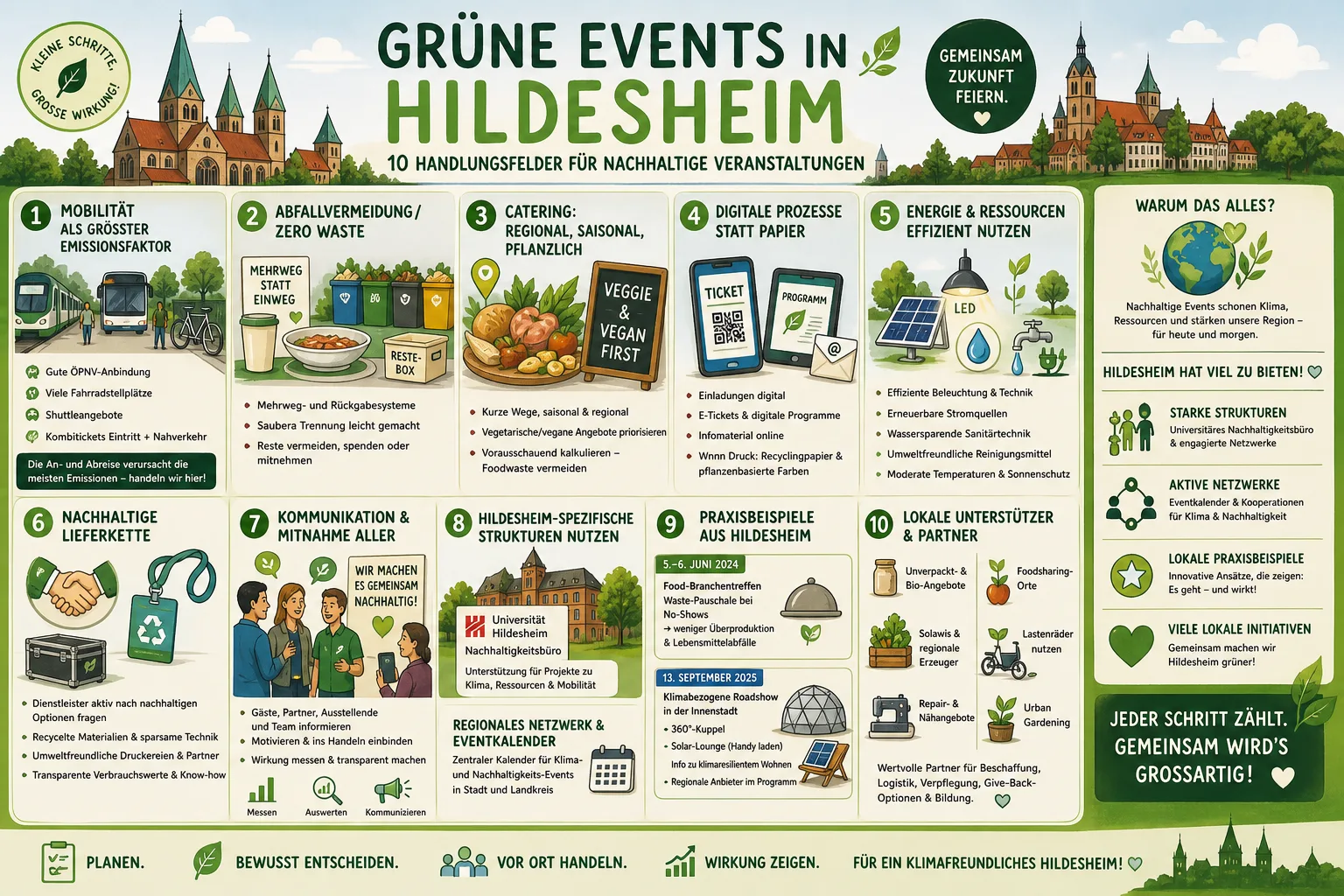
1) Green Mobility: The biggest lever for the climate impact of future events
At many events, most greenhouse gas emissions are not generated on site, but through arrival and departure. Those planning a Green Event in Hildesheim in the future can often achieve more with mobility measures than with individual decisions about decoration or giveaways.
This is how travel to Hildesheim becomes more climate-friendly
- Location selection with a focus on public transport: Choose (if possible) locations with good bus and train connections and communicate the appropriate lines and stops in the invitation, website, and ticket email.
- Public transport as the standard in communication: Formulate travel instructions so that bus, train, and bicycle appear as the "default" (e.g., "How to get there by bus & train" as the first section).
- Bicycle-friendly infrastructure: Plan clearly visible, well-lit parking spaces near the entrance; for larger events with an expected high number of bikes, an additional, temporary parking area can significantly ease the situation.
- Parking management: If parking is necessary, manage it actively (e.g., through clear signage, separate zones, possibly advance information) to reduce search traffic.
- Shuttles for gaps in public transport: For off-peak times or locations outside the main routes, a shuttle from central points (e.g., near the train station) can reduce the number of individual car arrivals.
Practical tip for planning: Set yourself a measurable goal in advance, e.g., "at least 60% arrival by public transport, bike, or on foot," and survey this after the event with a short questionnaire.
2) Zero Waste on site: Reusables, smart collection points, and clean processes
Zero Waste does not mean "perfect," but "consistently avoid." For upcoming events in Hildesheim, the rule is: Waste avoidance is more effective than just waste separation, because waste that does not arise in the first place does not need to be transported or disposed of.
The most important building blocks
- Reusable instead of disposable: Use reusable dishes, cutlery, and cups with a deposit and return system. This reduces littering and makes cleaning the site easier.
- Uniform separation: Plan clearly visible stations for residual waste, paper, and recyclables (possibly organic, if the disposal concept makes sense). Use clear terms and pictograms.
- Placement along the routes: Set up collection stations where people actually clear away: at food stands, seating areas, exits, and transitions.
- "Cleanliness scouts": Short briefings for helpers or teams who provide friendly support ("Here is the reusable return") increase the return rate and improve sorting purity.
Rules that guests understand
Formulate a maximum of three simple rules that appear identically everywhere (website, signage, announcement). Example:
- Please return reusables (don’t forget the deposit).
- Dispose of waste only at the collection stations.
- Please refill your own bottles/cups if possible instead of buying new ones.
3) Sustainable catering: regional, plant-based, and planned to prevent food waste
Food shapes the atmosphere – and influences the environmental balance. For future Green Events in Hildesheim, three levers are particularly effective: regional & seasonal, more plant-based options, and avoiding overproduction.
What can be implemented concretely
- Buy regional & seasonal: Prefer products from the region and season. This strengthens local value creation and (typically) reduces transport effort.
- Plant-based dishes as standard: Plan vegetarian and vegan options not as an "extra," but as the main offer. Animal products can be offered additionally.
- Quantity planning with commitment: Work with pre-registration, clear cancellation deadlines, and realistic portion calculations. This reduces the risk of preparing too much.
- Water for refilling: Set up clearly visible drinking water or refill stations so that fewer disposable containers are needed.
- Reusables in the catering process: Clarify washing and return routes in advance (distribution, return, transport, washing capacity) so that reusables work smoothly.
Note on food donations: If your future event plans to pass on leftover food, clarify this in advance with suitable local partners and observe hygiene and cold chain requirements.
4) Digital instead of paper: Tickets, program, and last-minute updates
Digital processes save resources and make events more flexible. For future events in Hildesheim, a simple rule has proven itself: digital first, paper only where it is really necessary.
- Digital invitation & registration: Email, web form, and calendar invite reduce printing, postage, and coordination effort.
- Mobile tickets: QR codes on smartphones speed up entry and avoid single-use tickets.
- Online program: Program, site map, and information (reusables, travel) centrally available online; on site, a few well-placed info boards are sufficient.
- If print is necessary: Use recycled paper and pay attention to the most environmentally friendly printing processes possible.
5) Energy, resources, and supply chain: The invisible backbone of a Green Event
In addition to mobility, waste, and catering, energy consumption and procurement influence the overall impact. Anyone who wants to organize more sustainably in Hildesheim in the future should anchor these points early in tenders and agreements.
Energy & water
- LED and efficient technology: Modern lighting and well-thought-out light planning reduce electricity consumption.
- Use green electricity: Ask about green electricity tariffs at fixed locations or commission suitable solutions for temporary connections.
- Save water: Plan water-saving fittings and environmentally friendly cleaning agents, especially for sanitary and washing concepts.
Procurement & service providers
- Sustainability criteria in contracts: Agree on reusable requirements, waste separation, return and cleaning processes in writing.
- Materials with low environmental impact: Prefer durable rental or reuse options (furniture, tents, signage) instead of one-off purchases.
- Transparent supply chain: Ask service providers for brief information on energy source, transport routes, and material selection to make decisions transparent.
Guidance for larger events: Those who want to build a systematic management system can refer to the standard ISO 20121 (Sustainable Event Management).
6) Hildesheim as a location: Cooperations and local resources for upcoming events
In Hildesheim, there are actors from universities, civil society, and the local economy who can support future zero-waste and green event concepts. Cooperations that provide materials, knowledge, or infrastructure are particularly helpful.
Cooperation ideas suitable for future events
- University and educational actors: For workshops, information stands, or program elements on sustainability, circular economy, and climate-friendly mobility.
- Foodsharing and social initiatives: For coordinated concepts to avoid food waste (with clear hygiene and logistics rules).
- Regional producers: For seasonal catering and short supply chains.
- Repair and upcycling groups: For hands-on activities or for the repair/reuse of decoration and equipment parts.
- Cargo bike offers: For low-emission logistics for small to medium-sized formats.
If you build cooperations, it is worthwhile to define common goals (e.g., reusable quota, amount of waste, share of arrivals) early on so that all participants work in the same direction.
7) Take away, measure, improve: This is how sustainable celebrations become routine
So that Green Events in Hildesheim do not remain the exception in the future, a simple learning loop is needed in addition to good planning: set goals, collect data, report transparently, improve.
A lean system for the next event
- Define goals: e.g., "reusable quota," "waste per guest," "share of arrivals without a car," "share of plant-based dishes."
- Measure on site: Waste (bag/container count or weighing), return rate for reusables, short survey on arrival.
- Evaluate after the event: What worked, where were there issues (return, signage, logistics, communication)?
- Share results: A short, honest review builds trust and makes it easier to introduce higher standards next time.
This is how a new normality is created step by step: events where climate-friendly mobility, zero waste, resource-saving catering, and digital organization naturally go together.