
Further Education in Hildesheim: Educational Leave & Opportunities
Further Education in Hildesheim 2027+: Inspiration for Mind & Career (Outlook)
7 min readLaura Müller
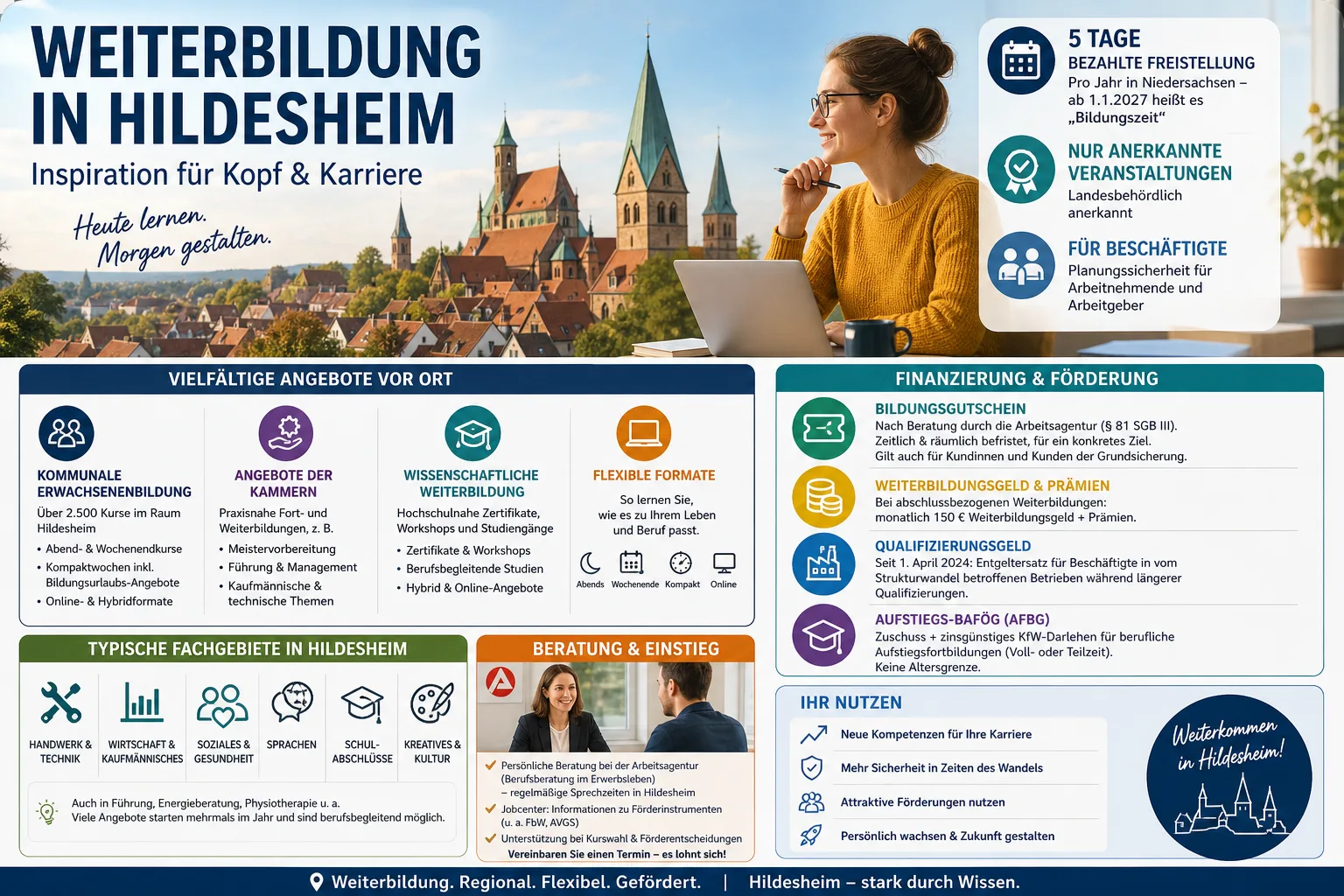
Anyone looking to advance professionally or reorient themselves in the city and district of Hildesheim in 2027 will likely encounter a wide range of courses, certificates, and advanced training opportunities. Particularly relevant: As of 01.01.2027, the previous "educational leave" in Lower Saxony is to be modernized as "educational time"—with the aim of making learning formats more flexible without losing sight of the fundamental entitlement.
This article is written as a future and planning guide for 2027 and the following years: Which rights could you use, which funding paths are typically to be planned, and how do you find a format in Hildesheim that fits your everyday life?
From 2027: Strategically Plan Educational Time
For employees with an employment relationship in Lower Saxony, the most important lever will likely remain a legally regulated leave of absence for further education even after 2027. If the announced switch to "educational time" becomes effective on 01.01.2027, you should align your annual planning with it early on:
- Timing: Ideally, plan educational time several months in advance (course start, recognition, application to employer, substitution).
- Recognition: Prefer events that are recognized for educational time or are likely to be eligible for recognition.
- Added value: Prioritize courses that either cover specific job requirements (e.g., new software, professional updates) or support your medium-term direction (e.g., project management, leadership, language).
If you see educational time as part of your personnel development (instead of as a "single measure"), you can combine more purposefully in 2027: for example, a compact intensive week plus a longer part-time module afterwards.
Which Offers Are Particularly Obvious in Hildesheim in 2027
For 2027, a mix of municipal adult education, chamber offers, private education providers, and university-related formats can typically be expected in the Hildesheim area. This division can help your planning:
1) Compact Formats (Ideal for Educational Time)
For an educational time week, intensive trainings with clear topic encapsulation are likely to be particularly suitable, for example:
- Basic and advanced courses in digital tools (Office, collaboration, data basics)
- Communication & conflict resolution, moderation, presentation
- Language intensive weeks (e.g., Business English, German at work)
- Introductions to project management methods
2) Part-Time Certificates (Several Weeks to Months)
If you want to specialize in 2027, evening or weekend-based certificates will often be of interest, for example in:
- HR, purchasing, sales, controlling (depending on professional field)
- Quality management, process thinking, documentation
- IT basics (e.g., IT security basics, data protection overview)
3) Advanced Training & Exam-Oriented Courses
For career steps towards specialist or management responsibility, courses preparing for public-law exams (e.g., master craftsman or specialist paths, depending on trade/profile) will remain relevant in the environment of chambers and education partners in 2027 as well.
4) University-Related Further Education (Scientifically Based, Often Modular)
If you want to remain or become academically eligible in 2027, further education certificate modules or part-time study formats (depending on availability) can be an option. For planning, especially important: admission requirements, workload per semester/module, and attendance components.
Financing 2027+: Timing Funding Instruments Correctly
If you are aiming for a larger qualification in 2027, it is worthwhile to consider financing and schedule together. In Germany, (depending on status: employed, job-seeking, in retraining) these instruments are particularly relevant for planning:
Education Voucher (SGB III) – When a Recognized Educational Goal Is Pursued
In 2027, an education voucher can still play a central role if further education is demonstrably intended to improve labor market opportunities. A prior consultation is typical, in which the educational goal, type of measure, and framework conditions are clarified. Important for planning: Often only measures/providers that meet formal approvals are eligible for funding.
Further Education Allowance & Bonuses – For Qualification Aimed at a Degree
If you are pursuing a qualification with a recognized degree (or comparable structure) in 2027, additional support may be possible. For your planning, this can mean: You consistently choose a degree-oriented path instead of stringing together individual courses loosely.
Qualification Allowance – When Company Transformation Requires Qualification
If your company is under pressure to adapt in 2027 (e.g., technology or process change), qualification within the company may gain importance. In such constellations, instruments that are intended to secure longer periods of further education within the company can be interesting. In practice, it is often crucial whether the employer strategically supports the further education.
Advancement BAföG (AFBG) – For the Next Career Step
If you are planning advanced training in 2027 (for example, towards master craftsman, specialist, or comparable advanced training levels), advancement BAföG can be a key component. For planning, the following are particularly important: course and exam structure, possible combination of grant and loan, as well as application deadlines.
Important for 2027: Funding conditions may change. Therefore, always plan a current check with the relevant authorities before signing a contract and coordinate course start, application, and decision in such a way that no funding gap arises.
Practical Fields with Typical Further Education Needs (Outlook 2027)
Which topics are particularly useful in 2027 depends on the industry and personal goal. In Hildesheim, these practical fields are likely to continue to be frequently offered:
- Craft & Technology: Specializations, safety/standards knowledge, energy-related topics, digital documentation, and modern construction site/workshop organization.
- Commercial Profiles: Data competence in everyday office life, process understanding, project work, legally compliant documentation (depending on role).
- Social & Health: Communication, de-escalation, team coordination, methodological deepening (depending on field of application), as well as quality-assured further training.
- Languages: Job-related language skills for customers, teams, or international interfaces.
- Leadership & Collaboration: Team leadership, feedback culture, conflict management, change competence—especially if companies are restructuring more in 2027.
If you are torn between several options in 2027, a simple principle helps: Choose the topic that either measurably increases your employability (e.g., through a recognized degree) or noticeably relieves your current role (e.g., better tools/processes).
Consultation & Decision: How to Structure Your Next Step
In 2027, it is worthwhile to use consultation not only when the course has already been selected. This order is more effective:
- Clarify goal: Advancement in the current field, lateral entry, job stabilization, or formal qualification?
- Set time frame: Educational time week, 3–6 months certificate, or 1–2 years further training (depending on model).
- Check funding route: Which office is responsible (e.g., Employment Agency/Job Center, AFBG office, company options)?
- Compare offers: Learning format, exam components, attendance/online, total costs, cancellation rules, transparency of learning objectives.
- Coordinate with employer: Leave of absence, substitution, benefit argumentation, possibly co-financing.
If you are new to further education in 2027, a short trial course or an information evening can be a sensible start—especially to test learning rhythm, expectation level, and fit with everyday life.
Short Checklist for Your Planning 2027
- I have defined a concrete goal (role/qualification/competence) for the next 12 months.
- I have set my realistic time corridor (week format vs. part-time).
- I only check offers with a transparent description of learning objectives, scope, and costs.
- I clarify before the course starts whether educational time recognition or funding eligibility exists.
- I plan buffers for application, approval, and organizational coordination.