Cultural Education and Discourse in Hildesheim
Cultural Education & Societal Discourse in Hildesheim: Preview of Upcoming Formats and Debates (from 2026)
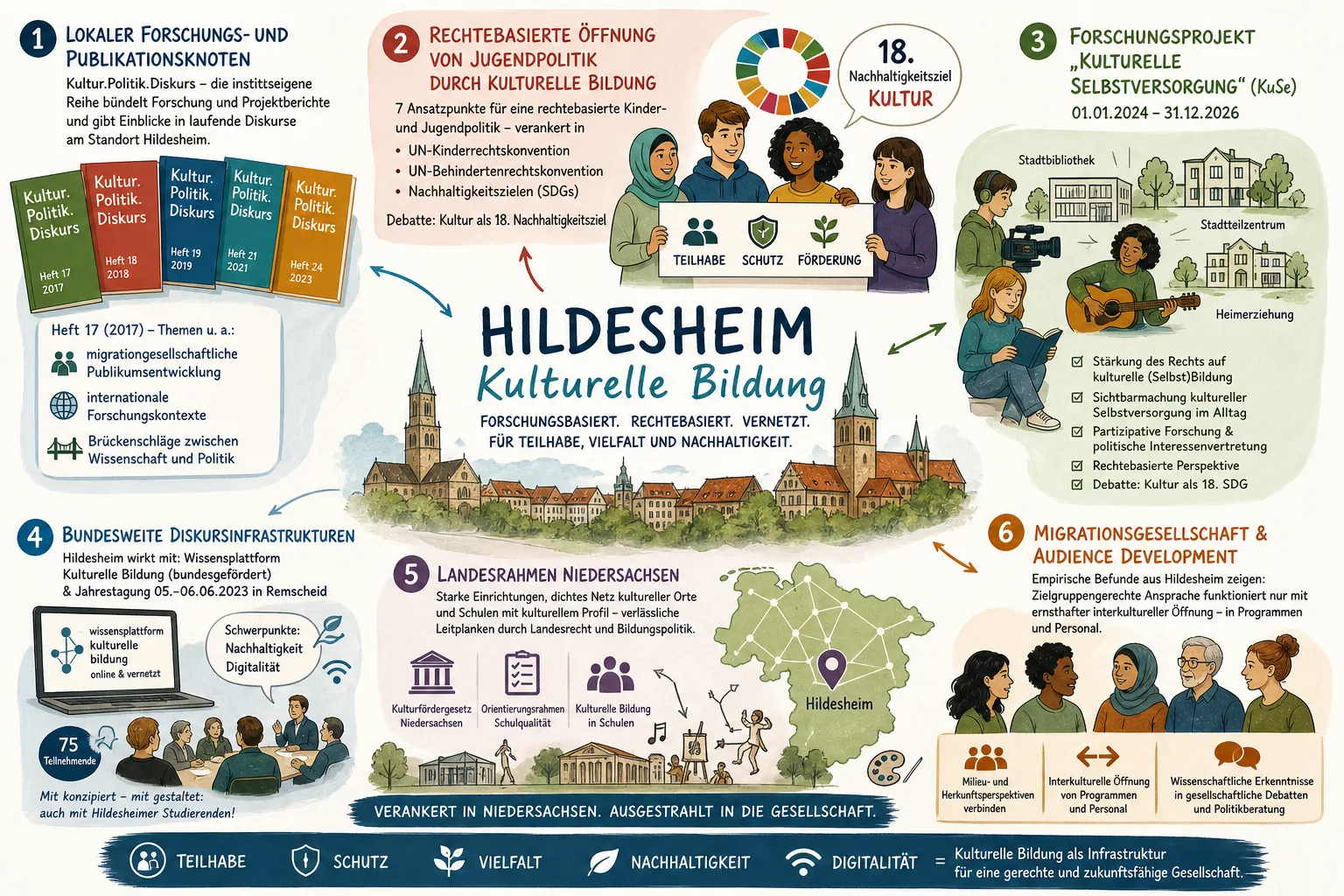
What could a city look like in the future if children, young people, and adults not only attend culture but actively help shape it as part of their rights? For Hildesheim, several future lines of discourse and upcoming practical formats can be outlined for the coming months and years: a more rights-based cultural education, new approaches to cultural self-sufficiency for young people, as well as debates on digitality, sustainability, and participation in a migration society.
Rights-Based Cultural Education: What Should Become Concrete in the Next Steps
In the coming years, it is expected that cultural education offerings in Hildesheim (as in many cities) will be increasingly understood as the implementation of children's rights, participation rights, and inclusion rights. This orientation can be guided by key international references in the future:
- the right of children to participation and development (UN Convention on the Rights of the Child),
- the right to equal participation for people with disabilities (UN Convention on the Rights of Persons with Disabilities),
- the goals of sustainable development (Agenda 2030), which combine social, ecological, and institutional development.
Which Practical Steps Will Make Sense Next in Hildesheim
If cultural education is consistently planned on a rights-based approach from 2026, the following steps will typically become relevant in the next phase:
- Removing barriers: Access (cost, language, mobility, times, spaces) is systematically reviewed and reduced.
- Making participation binding: Children and young people receive fixed roles (e.g., advisory boards, jury formats, co-moderation) instead of occasional “participation” invitations.
- Ensuring protection and well-being: Protection concepts, discrimination-sensitive complaint procedures, and reliable contact persons become standard.
- Consolidating cooperation: Cultural venues, schools, youth welfare, and libraries plan together beyond the duration of individual projects.
- Making quality measurable: Goals are operationalized (e.g., reachable groups, dropout rates, satisfaction, perceived self-efficacy).
In public debate, the question of what role culture plays for sustainability will likely become more acute in the coming years. Cultural education can increasingly serve as a space for translation and negotiation: It makes complex goal conflicts (e.g., climate protection vs. social burdens) tangible, discussable, and shapeable.
Cultural Self-Sufficiency: What Projects Can Emerge in Everyday Places
For Hildesheim, it will be particularly relevant in the coming years to consider cultural education where young people spend their everyday lives. Future projects for cultural self-sufficiency can start in places that are low-threshold and accessible—such as libraries, neighborhood and youth centers, and youth welfare institutions.
Which Formats Can Realistically Be Planned from 2026
- Co-curated spaces in libraries (e.g., maker/media corners, writing or comic studios, audio/podcast stations) with binding participation rights for young people.
- Peer formats, in which young people guide other young people (e.g., music production, video, theater, urban art) and receive training and recognition for this.
- Mobile workshops for neighborhoods: short cycles with recurring dates so that participation does not depend on the coincidence of individual events.
- Reliable retreat and expression spaces in youth welfare that allow creative work and at the same time provide protection.
To ensure that cultural self-sufficiency does not remain “invisible” in the future, it will be crucial in many projects from 2026 to consider documentation and visibility: Exhibitions, readings, open rehearsals, digital portfolios, or neighborhood presentations can ensure that cultural practice becomes visible as part of the municipal public sphere.
Fields of Transformation: Digitality and Sustainability in Upcoming Programs
In the coming years, cultural education programs in Hildesheim will likely be planned more strongly along two fields of transformation: digitality and sustainability. Both topics are only viable if they are not understood as add-ons, but as quality requirements for content, methods, and equitable access.
Digitality: What Will Be Important in the Next Phase
- Digital participation: Offers are planned so that device access, secure accounts, data protection, and guided use are taken into account.
- Media competence as expressive competence: Digital tools are not only taught technically, but used as means for storytelling, critique, design, and participation.
- Hybrid formats: Workshops can start on site and continue online in the future, so that participants can stay involved.
Sustainability: How Artistic Practice Remains Relevant in the Future
- Resource-saving production (choice of materials, reuse, local cooperation) becomes part of project planning.
- Aesthetic engagement with climate impacts, justice, and visions of the future is taken seriously as a legitimate educational content.
- Good participation: Sustainability is not “prescribed” but negotiated in projects that respect different life situations.
Migration Society & Audience Development: Future Standards of Openness
For the coming years, it is foreseeable that audience development in culture and cultural education will be defined less by reach alone, but by the question: Who can feel a sense of belonging, co-decide, and become visible? This results in standards that can play a greater role in Hildesheim in the future (as elsewhere).
What Intercultural Openness Can Mean in Practice in the Future
- Co-creation instead of target group approach: Formats are developed together with communities—including topic selection, aesthetics, and location.
- Diversity in responsibility: Diversity of perspectives is considered at management and decision-making levels.
- Discrimination-sensitive quality: Training, feedback and complaint procedures, as well as clear agreements on how to interact with each other, become more binding.
- Multilingualism and comprehensibility: Communication is not only translated in the future, but consistently made accessible (plain language, clear information, visual orientation).
In the next phase, societal discourse will likely be measured by whether openness is understood as a structural change—and not as a short-term communication campaign.
Getting Involved in Hildesheim: How Interested People Can Find Upcoming Offers
From 2026, those who want to participate in or help shape upcoming cultural education formats in Hildesheim will typically find them through several channels:
- Municipal information channels (event calendars, participation platforms, public notices in neighborhood and youth facilities).
- Libraries, schools, youth welfare, and socioculture, which distribute invitations to workshops, series, and participation formats.
- Public event venues (theaters, museums, cultural centers), which will increasingly offer participation formats alongside performances.
For reliable participation, it will likely be crucial in upcoming programs that offers are announced early, are easily accessible, and are organized in recurring rhythms (rather than as one-off events).