Interreligious Events & Festivals in Hildesheim
Interreligious Events & Cultural Festivals in Hildesheim: Outlook on Upcoming Dates
7 min readLaura Müller
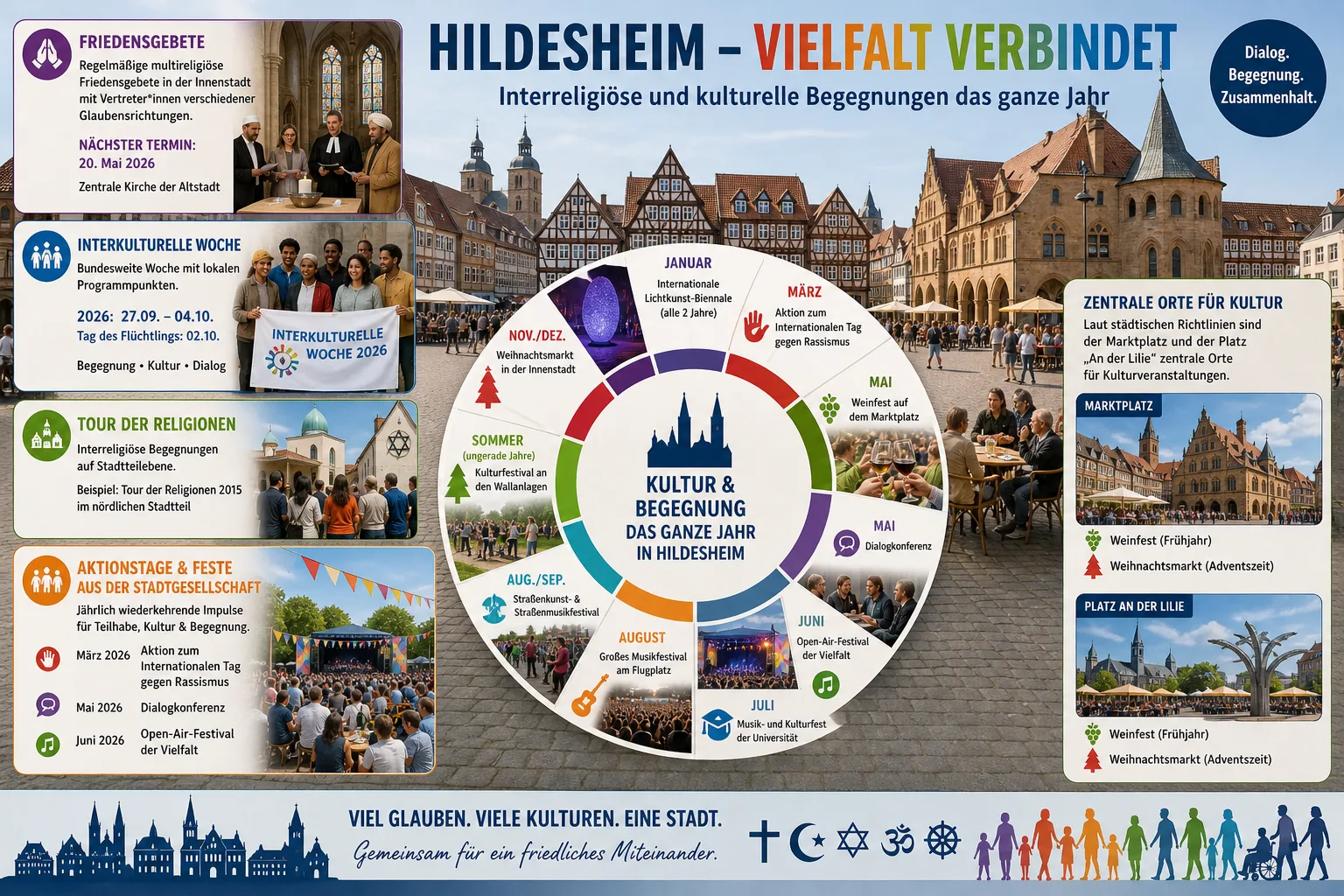
Can a city ring with church bells, the muezzin's call, and street music at the same time—and remain peaceful? In Hildesheim, this question will continue to be answered anew in the coming months: through open prayers, dialogue formats, festivals in central squares, and cultural programs in the neighborhoods.
This overview looks ahead: What formats you can typically expect in the next season, how to find reliable dates, and how to participate—as a guest, as a contributor, or as an initiator of your own contribution.
Interreligious Formats: Encounter, Prayer, and Conversation
For the upcoming event year, several interreligious formats can be expected in Hildesheim, which are publicly accessible and deliberately low-threshold. These include, in particular, multi-voiced prayers for peace and understanding, evening discussions, and thematic encounter meetings where religious communities and civil society initiatives appear together.
Characteristic of such evenings is the clear common thread: peace, respect, understanding, and coexistence in the city. Contributions can be designed as short impulses, readings, music, elements of silence, or moderated discussion rounds. If you would like to participate, it is worth paying attention to notes on accessibility, language (e.g., multilingual moderation), and event format (in-person/hybrid).
- For visitors: Feel free to arrive a few minutes early; personal conversations often arise before or after the official part.
- For groups and congregations: Many events thrive on cooperation. It is common to register as a program partner with the respective organizers.
- For newcomers: Interreligious offerings are often suitable as a first contact with the local urban community, without requiring a religious affiliation.
Intercultural Week & “Day of the Refugee”: Networked Nationwide, Implemented Locally
In late summer/early autumn, the Intercultural Week (IKW) is usually held in Germany. For Hildesheim, a local program can also be expected in the coming season, which is based on the nationwide framework and is supplemented locally by associations, educational institutions, religious communities, initiatives, and organizations.
Typical program points that you will likely find again in the next IKW program booklet or online calendar are:
- Readings, film evenings, and discussions on participation and coexistence
- Exhibitions and city walks focusing on migration, history, and the present
- Encounter cafés, hands-on activities, and discussion formats in neighborhoods
- Worship services and interreligious impulses in the context of diversity
Within the IKW, the “Day of the Refugee” is also set nationwide. For Hildesheim, events can also be expected in the future that make the perspectives of people with a refugee background visible, bundle counseling opportunities, or open spaces for exchange. Reliable detailed information (location, time, accessibility) can be found shortly before the action week in the official program lists.
Neighborhoods & Community: Guided Tours, Open Doors, and “Tours of Religions”
Not all interreligious and intercultural offerings are concentrated in the city center. For the next season, formats can be expected that deliberately go into neighborhoods and districts—such as guided tours, “open door” days, or thematic “Tour of Religions,” where several congregations are visited one after the other as stations.
Such tours usually combine three elements that make them particularly effective:
- Insight: Spaces, rituals, and everyday practice are explained without missionary intent.
- Dialogue: Questions are expressly welcome; there are often moderated discussion phases.
- Neighborhood: Encounters happen where people already live together (school, shopping, clubs).
If you would like to participate with children or young people, pay attention to notes on duration, route, and age restrictions. For groups, it may be advisable to register early, as the number of participants in congregation and meeting rooms is often limited.
Festival of Diversity, Action Days, and Dialogue Conferences: Culture Meets Attitude
Hildesheim is also expected to feature cultural festivals and action days in the coming season that not only celebrate diversity but also put it into a social context. Typical are open-air programs with music, dance, and cuisine, combined with information stands, counseling services, and workshops.
In addition, action days on anti-discrimination and social cohesion are often planned throughout the year. Such formats set visible signals in public spaces and are often accompanied by a supporting program (e.g., lectures, artistic contributions, educational offerings).
As a structured counterpoint to stage programs, dialogue conferences or expert discussions can be planned. There, perspectives from administration, science, civil society, and practice are bundled. If you would like to contribute, it is worth looking for participation formats (audience questions, working groups, open forums), which are usually explicitly mentioned in announcements.
Cultural Festivals Throughout the Year: What Is Likely to Happen When
Many cultural formats in Hildesheim follow a seasonal rhythm. Concrete dates may shift from year to year; however, the time window is usually reliable. This outlook will help you plan:
Spring: Marketplace Season & Outdoor Kickoff
In spring, a stronger start to events in central squares can typically be expected. The marketplace often becomes the venue for markets, culinary, and cultural formats. If a wine festival or a similar city center format is announced, it is worth paying attention early to information about admission times, safety rules, and family offerings.
Summer: Street Art, Street Music & City as a Stage
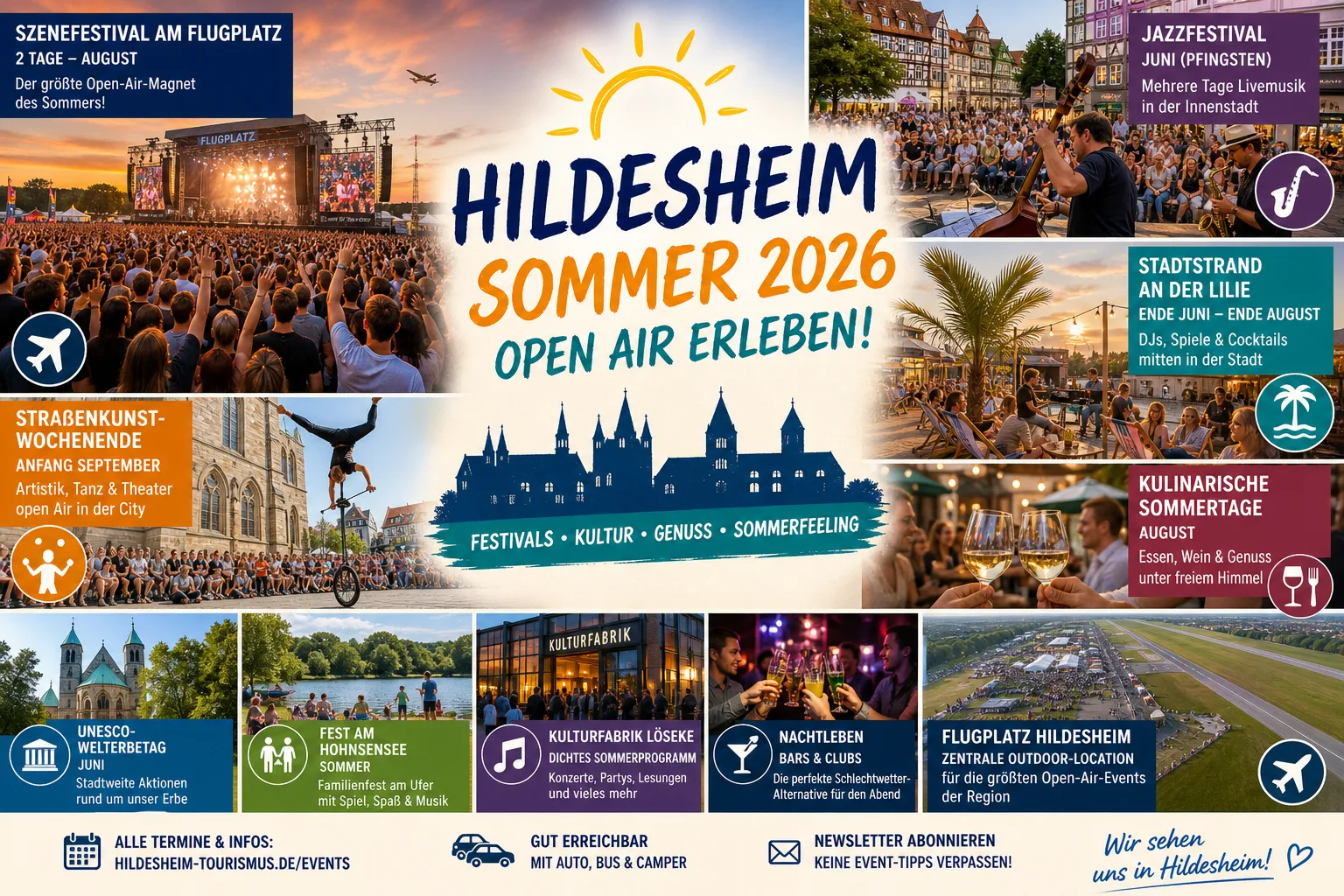
For summer, formats can be expected in which the city center becomes an open stage: street music, small-scale art, theater, and hands-on activities. Areas such as the marketplace or “An der Lilie” are often used as central anchor points. Especially practical: Many program points are accessible without a ticket, making spontaneous visits a good option.
Autumn: University and Cultural Programs, Focus on Encounter
In autumn, programs that link culture with education and city life are likely to become visible, for example through university events, exhibitions, or cross-genre cultural evenings. This period often also includes the Intercultural Week, which can concentrate several dialogue and encounter offerings.
Winter: Light, Art & City Center Atmosphere
In the darker season, light and cultural installations are particularly present in many cities. If a light art series, a winter cultural format, or a city center illumination is announced in Hildesheim, pay attention to running times, route recommendations, and notes on accessibility. Towards the end of the year, the Christmas market and accompanying cultural or concert offerings can also usually be expected.
Participation, Accessibility, and Sustainable Arrival: How to Be Well Prepared
For upcoming events, improvements in information and access are increasingly to be expected: multilingual announcements, notes on accessible routes, awareness concepts, and sustainable logistics. These points can be particularly helpful for your visit:
- Accessibility: In the announcements, look for information on step-free access, seating, sanitary facilities, and regulations for accompanying persons.
- Language & Comprehensibility: Many dialogue formats work better with clear moderation; notes on this are often found in the program text.
- Sustainability: Find out about public transport connections, bicycle parking, and travel recommendations, especially for larger festivals.
- Respectful Visit: For interreligious offerings, clothing or behavior guidelines may apply (e.g., photo rules, handling of prayer phases). These are usually communicated transparently.
Note on reliability: This article describes expected formats and time windows. Binding dates, locations, and program statuses can be found in the official event calendars and programs (see sources).