Discovering Industrial Culture & Architecture in Hildesheim
Industrial Culture & Architecture in Hildesheim: Your Future Walk to Visible Urban Layers
If you visit Hildesheim in the coming days or weeks, you can experience industrial culture and architecture as a coherent route: not as a “checklist” of individual sights, but as a sequence of urban spaces, materials, uses, and sightlines. This article describes a tour that you can flexibly plan in the future (self-guided or as a basis for a guided tour).
Goal: After the tour, you will be better able to recognize how the functions of places can be read in the cityscape: through building forms, courtyard situations, transitions between old and new buildings, traffic axes, and repurposing.
Planning: Duration, Starting Points, Maps & Tickets
- Recommended total duration: 3–6 hours (depending on whether you add Route 2 and a museum visit).
- Starting point (city center): Area around the main train station or the central city center—choose the place that fits your arrival.
- Alternative starting points: Tourist information (for maps/recommendations) or a central square where you can orient yourself well.
- Tickets/public transport: If you plan to include Domäne Marienburg, your route will likely include public transport or bike/taxi segments. Check current lines, schedules, and possible construction sites in advance.
To make the tour “work” for you, consciously plan breaks in the future: industrial culture often reveals itself through details (material changes, masonry joints, courtyard edges, window formats) that are easily overlooked in passing.
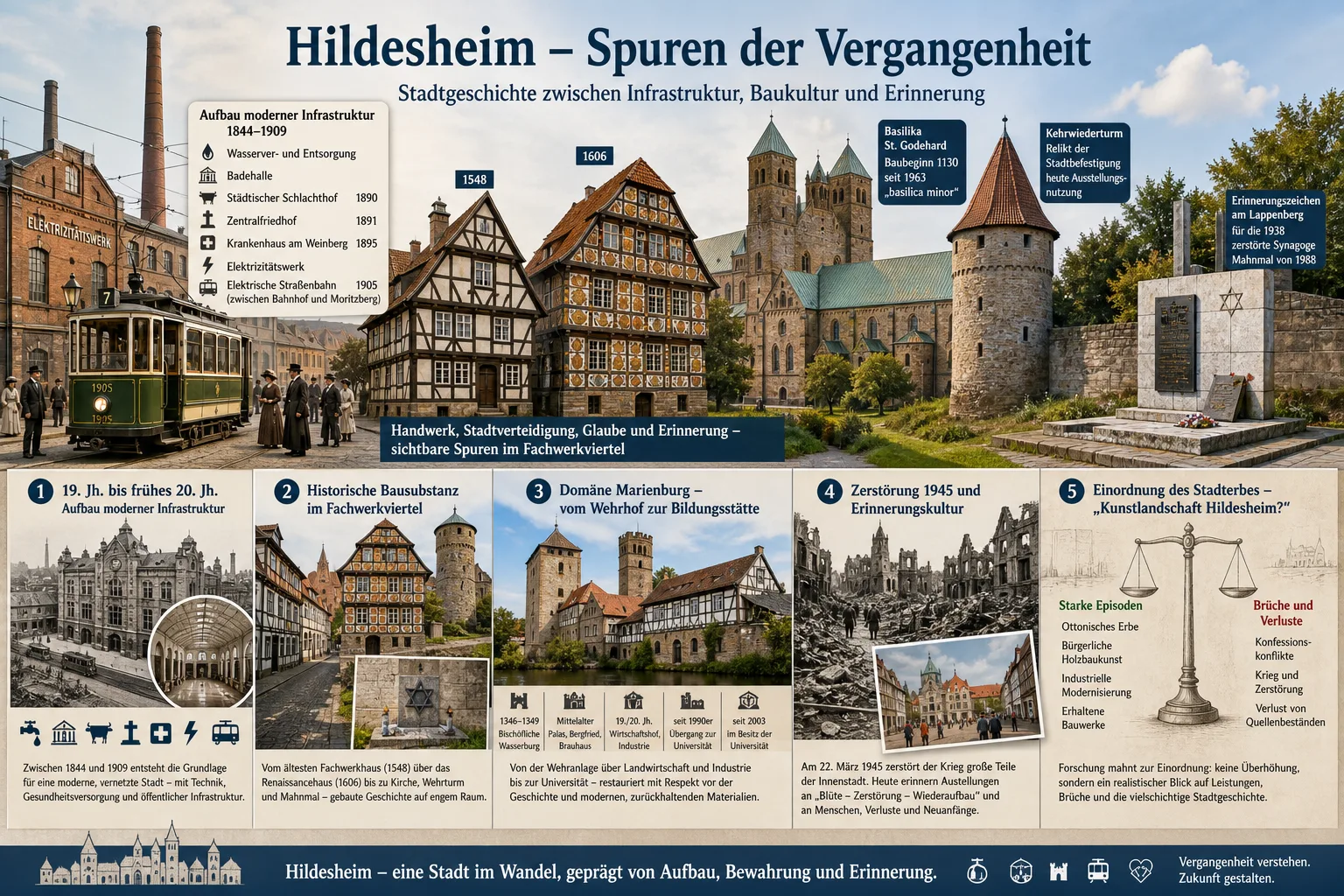
Route 1 (City Center): Half-timbered Houses, Squares, Transitions
On this city center route, you will be able to practice especially well how to “read” architecture in the future: Pay attention to the edges between small alleys and wider street spaces, to the effect of height gradations, and to the way ground floors are used (gastronomy, retail, residential, culture).
1) Alleys & Facades: What to Specifically Look For
- Rhythm of facades: Repetitions of window axes, projections, bay windows, or shop zones give you clues as to how a street will “function” in the future (staying vs. passing through).
- Material changes: Transitions between wood, plaster, brick, natural stone, and metal are often recognizable at extensions and conversions.
- Ground floor zone: Shop windows, doors, driveways, and courtyard entrances show you whether a building is more oriented towards public traffic or internal use.
2) Towers, Churches, Courtyards: Landmarks for Your Walk
Plan 2–3 “fixed points” as orientation in the future—e.g., a tower, a church, and a square. From there, you can walk loops without getting lost, and when you return, you will clearly perceive changes in perspective and scale.
3) Memory in Urban Space: Perceive Respectfully
If you come across memorial sites, your walk will become quieter and more focused. Take conscious time for this, read inscriptions in full, and avoid “shortcuts” across areas designed as places of remembrance. In this way, your future route will be not only architecturally but also culturally coherent.
Route 2 (South): Domäne Marienburg as an Ensemble
If you integrate Domäne Marienburg into your future visit, you will experience a coherent ensemble where uses, pathways, and courtyard spaces can be particularly well observed. Plan extra time for this, as the site usually invites you to explore several indoor and outdoor spaces in succession.
Arriving & Reading: How the Site Reveals Itself
- Access & edge: Pay attention to transitions between “outside” (paths, greenery, water/moats if accessible) and “inside” (courtyard spaces, walls, gates).
- Courtyard space: Stand in the middle of the courtyard and slowly turn around once: Which sides appear “representative,” which “functional”?
- Building bodies: Compare roof shapes, window bands, gates, and extensions. You will quickly recognize how requirements for use are translated into building forms.
- New additions: If modern components or materials are used, you can check whether they are clearly distinguishable from the existing structure—a principle often applied in many extensions to existing buildings.
Route 3 (City Axes): Reading Infrastructure in Today’s Urban Life
Industrial culture will not only be visible in the future where “industry” is prominently displayed, but above all in urban functional places: supply, mobility, logistics, health, education. On this route, you will head for fewer “sights,” but will consciously follow axes and transitions.
What You Can Observe Along the Way
- Width and course of streets: Straight lines, generous junctions, and long sightlines often indicate planned traffic logics.
- Edges & zones: Where do residential use, commerce, greenery, rail or bus corridors change? These edges usually tell more than individual facades.
- Everyday buildings: Halls, workshop buildings, backyards, fences, ramps, and driveways are often more meaningful for industrial culture than “beautiful” fronts.
If you walk this route soon, it is worthwhile to pause briefly at three points: once at a traffic junction, once at an interface between residential and commercial areas, and once at a place where repurposing is visible (e.g., culture, education, or services in formerly functional buildings).
Optional: Museum & Exhibitions as Context (During Your Visit)
If you visit a museum or exhibition during your future stay, it can structure your observations “outside”: maps, photos, models, and thematic rooms help to classify scales and clarify terms (e.g., urban expansion, repurposing, monument preservation, traffic planning).
Check the current opening times, ticket conditions, and any event calendars on the official websites of the city or institutions in advance. This way, you avoid waiting times and can pace your tour sensibly.
Checklist for Your Walk
- Choose route: city center only (compact) or plus Domäne Marienburg (extended).
- Notes/sketches: 5 observations on material, use, transitions, courtyard spaces.
- Respect & quiet: Visit memorial sites and religious spaces with appropriate behavior.
- Accessibility: Expect cobblestones, steps, and uneven paths; plan alternatives.
- Weather: Pack an extra layer—standing and looking cools you down faster than walking.
Sources & Further Information
- Hildesheim Marketing (Tourist Information & Visit Planning) — practical info for future visits (accessed 2026-09-23)
- University of Hildesheim — information on locations and access (accessed 2026-09-23)
- City of Hildesheim (official website) — information on facilities, arrival, and current updates (accessed 2026-09-23)
- Deutsche Bahn — travel planning for your future arrival and departure (accessed 2026-09-23)