Children's University Hildesheim: Discovering Science for Children
Children's University & Science Events in Hildesheim: What's Coming Up Next and How Families Can Find Suitable Dates
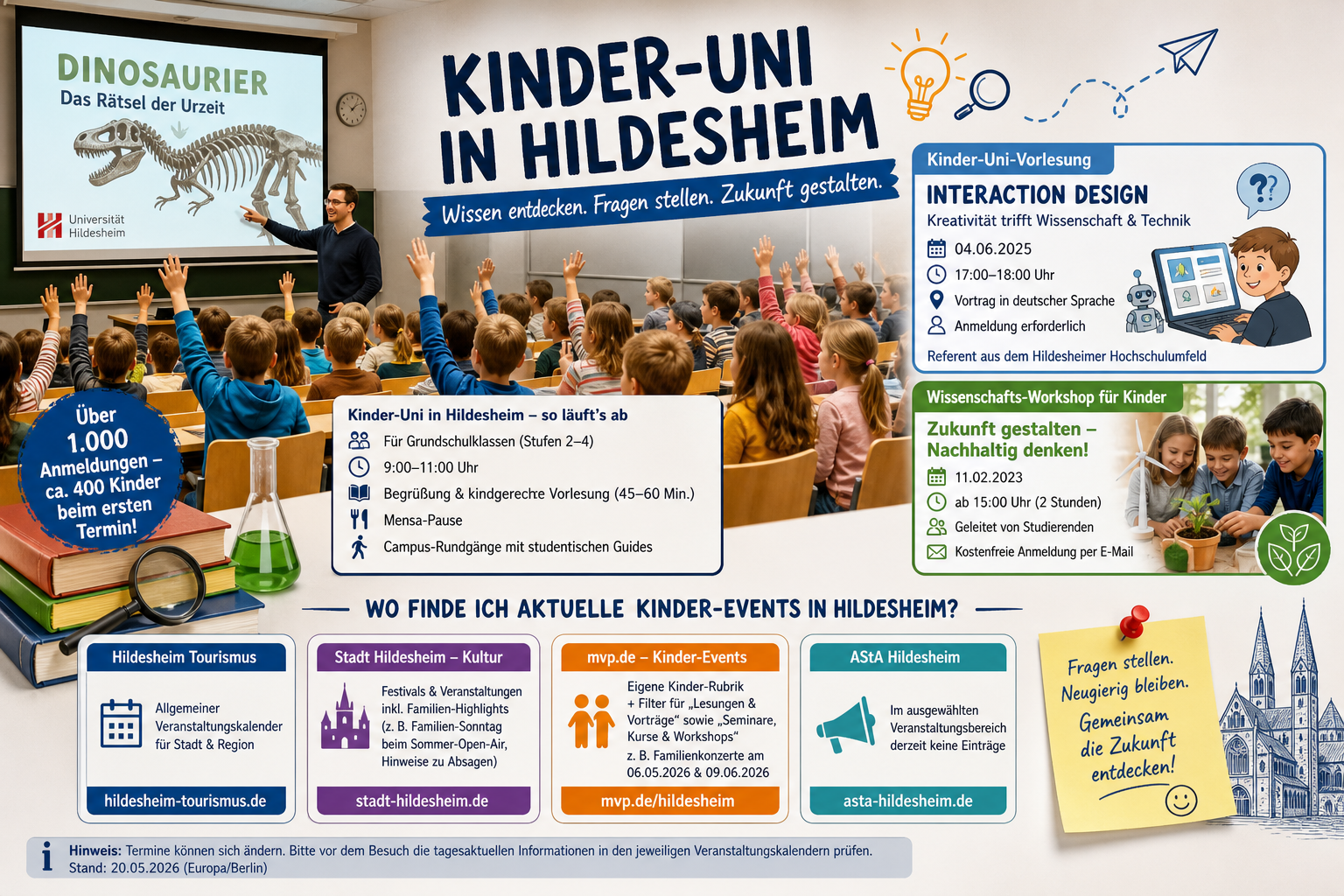
What does it feel like when a primary school class suddenly sits in a lecture hall instead of a classroom – and has real researchers right in front of them? Exactly these kinds of experiences are made possible by Children's University formats and science-related hands-on events in Hildesheim. This overview helps you realistically assess upcoming offerings, find suitable dates, and prepare well.
Currentness: This article describes exclusively future, recurring, and announced event formats. Specific dates and registration start times may vary depending on the organizer and should be checked in the official calendar before participation.
What Makes the Children's University (and Similar Formats) Special for Hildesheim Primary School Children
Children's University events are usually designed to be understandable, exciting, and school-related for primary school children. The offerings often target class groups (often grades 2 to 4) and are scheduled so that they fit as a morning excursion into the school day.
- Low-threshold entry: Science is conveyed as something tangible – with examples from everyday life, nature, technology, or media.
- Authentic learning environment: Children get to know a campus, lecture hall, or workshop area as a “real place” where questions are expressly welcome.
- Dialogue instead of frontal teaching: Good Children's University formats deliberately plan time for questions, short interactions, or vivid demonstrations.
Typical Schedule: How to Plan a Children's University Morning in Hildesheim
Even though every program is different, many Children's University events are similar in structure. This is practical for teachers and families because travel and time windows can be well calculated.
- Arrival & Welcome: Brief introduction by the organizing team, often with child-friendly behavior and safety information.
- Lecture or Live Input: A topic is explained in an age-appropriate “mini-lecture” or stage format – usually with pictures, objects, or short experiments.
- Break: Depending on the location, there is a snack or cafeteria option; for school groups, break logistics are often coordinated in advance.
- Campus/Location Insight: Often followed by a tour (e.g., library, workshop, rehearsal rooms, media rooms), depending on accessibility and program.
- Conclusion & Return: Short outlook, sometimes with impulse questions for classroom discussion or family conversation at home.
Practical tip: For highly sought-after events, registration deadlines and group sizes are crucial. Schools should check the organizer's official information early and clarify participation conditions (accompanying persons, photo rules, accessibility) in advance.
Which Topics Frequently Occur in Upcoming Children's University and Science Events
In Hildesheim and the region, science-related children's formats are often broadly themed. In addition to “classic” natural sciences, there are increasingly offerings that connect to children's everyday life and future issues.
Sustainability & Future: From Thinking Along to Participating
Many upcoming workshops focus on practical tasks: What makes a city livable? How can resources be saved? How do cycles work in nature and technology? Good formats combine knowledge impulses with creative tasks (building models, sketching ideas, presenting solutions).
Digital Worlds & Interaction Design: Explaining Technology in an Understandable Way
Interaction design is particularly suitable for children because it is directly connected to their media everyday life: What makes an app understandable? Why are buttons designed the way they are? In hands-on settings, children can develop simple operating ideas, draw interfaces, or playfully test “usability” – without needing programming skills.
Science Communication for Children: Clear, Safe, Fair
Serious children's formats take care not to overload content or create fear. Instead, curiosity, questions, and joint discovery are the focus. Especially with future topics (climate, AI, health), clear, child-friendly language is important.
Where You Can Reliably Find Upcoming Dates in Hildesheim
Since events are organized by different actors, a mix of official calendars and institutional programs is worthwhile. For the most reliable information, the original announcements of the organizers are decisive.
- Official city and tourism calendars: Public family and cultural events are often bundled there, including filter options.
- Institutional sites (universities, museums, educational initiatives): Children's University series, theme days, and workshops are often published there first.
- Regional event platforms: Practical for cross-comparisons, but: Always check details (places, times, registration) with the original organizer.
Recommendation: Check dates again shortly before attending. For free events and limited places, changes and contingents are possible.
How Families and Schools Select the Right Offer
- Match age & format: Younger children often benefit from shorter inputs; older primary school children like tasks where they can design or test something themselves.
- Take the child's interests seriously: “Science” can be nature, technology, culture, language, design, or environment – motivation increases when the topic fits.
- Pay attention to participation conditions: Registration, accompanying persons, accessibility, photo/media rules, and any materials should be clear in advance.
- Plan a conversation afterwards: A short exchange (“What was the most important question today?”) reinforces the learning effect and makes the experience lasting.